
Mew Design is a design agent I built with a few friends while we were unemployed in 2025.
It went from zero to one with about one and a half people, plus a lot of tokens. On the last day of 2025, it became profitable.
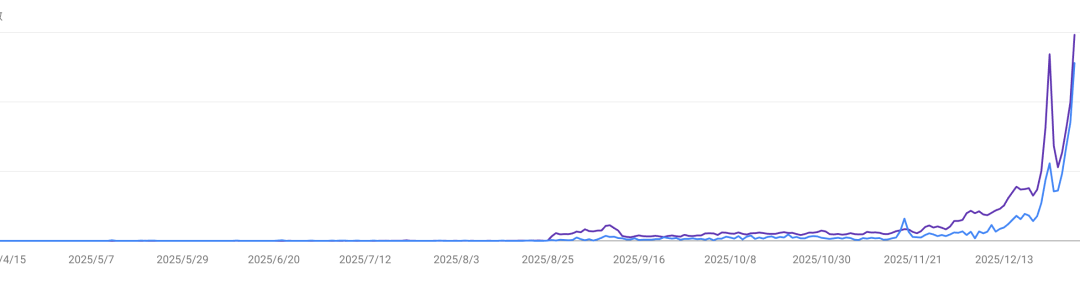
A few days ago, I saw Mew Design recommended in Guancha’s “February Treasure AI Products” list. Guancha is one of the more influential AI product discovery communities in China. I was flattered, and also a little emotional.
I read through every comment that night and decided to write this down: how we used AI to turn an idea into a product over the past year, and how it eventually made money.

There is an old Chinese saying: “It does not matter whether the cat is black or white. A good cat catches mice.”
That later became our product value: deliver results, not spectacle. That is also how the name Mew Design came about.
01 - The Beginning
I started building AI agent products quite early, roughly around the same time Dify appeared. When Coze first entered public view, I had just decided to give up on building an agent platform.
It was not because I did not want to continue. It was mostly for a few reasons:
-
Products in the LLMOps and AgentOps space would eventually become more and more similar. The difference would be more about business model than feature stacking.
-
My boss would not give the project resources, so many ideas could not land in execution.
-
There was no real moat. Whether it was RAG or workflow, the whole thing felt heavy. Later I came across a project called open-interpreter and suddenly understood: coding was the future.
That was near the end of 2023.
In 2024, I joined an AI company and worked on a generative UI project. The generative UI direction Google recently showed was something we had already built demos and validations for in 2024, before Claude 3.5 was released.
The project did not work out in the end, and I left. I felt regret, but also relief.
I used to think an ideal team would spend every day discussing better architecture and better solutions. The reality was that I had to teach algorithm colleagues how to call the OpenAI API, then repeatedly explain why images retrieved by RAG could not be used directly for image generation. I was exhausted.
That was also when I realized that the large model era is a new beginning. It does not matter who had which title before, who was a doctor, who was a director, who was a VP. Everyone is starting again.
Whoever runs faster gets the advantage.
After I quit without another job lined up, I felt unconvinced. I did not want the work from the first half of the year to be wasted, and I wanted to prove that my judgment was not wrong. So I spent two weeks building a small plugin to validate the direction again.
The conclusion was simple: it works. Then I will keep going myself.
02 - Starting Up
I set the direction around design agents, and only around image-and-text design. Later, when some investors talked with us, they hoped we would expand the scope a bit. I did not want to, so those conversations ended there.
Then I pulled in a designer friend, and we started moving together.
The domain was bought on January 4, 2025. The first version went online on March 12.
The code was written by me and AI together. At the time I was using about three Cursor windows at once, so you could say they were also early founding members.
But after launch, there was nothing. We had no money for marketing, and we did not know how to market either.
Most of the people around me were in the AI circle, but I did not really want to introduce the product to them. They were not the target audience. So we had to find friends in the design world and ask them for professional feedback, then keep changing the product from there.
Cold start is a hard barrier, especially when none of us had real experience doing it.
Later we pulled in another friend who worked on overseas growth.
With three people, the team was basically formed.
During this period, we also kept recruiting new AI employees and splitting work out to them.
03 - Product
I have worked on products for around ten years: three years as an AI product manager, one year as a builder.
Mew Design is the first product I have been able to polish fully according to my own ideas.
Many people look at us through the lens of AI products and give suggestions:
- Why can users not choose the model?
- Why can community works not show other people’s prompts?
- Why not make a prompt manual?
Those suggestions are all reasonable, but they are not right for us.
Mew Design is powered by AI, but it is first a design product. More precisely, it is a design product for normal people and non-designers.
Many of our users do not understand design in the first place. Asking them to understand models would make things even harder. So we try to give users the best possible result through the simplest possible interaction.
That is why we made many choices that look “against AI product common sense”:
-
Hide model complexity as much as possible, so users do not have to make technical decisions first.
-
Make the community emphasize results and quality, not turn it into a prompt competition.
-
Put “can it deliver a highly usable design” before “how much configuration freedom does it offer.”
These trade-offs will be questioned, but they are right for our target users.
I believe products are not built so people who already understand them can show off. They are built so people who do not understand can still get results.
04 - About Vibe Coding
The technical architecture, framework selection, product design, agent architecture, CI/CD, deployment, operations, code, and tests of the whole project were basically completed by me and AI together.
When I started the project, I had never written a single line of TypeScript.
About vibe coding, I still hear two extreme opinions:
-
“AI can never replace me.”
-
“AI can already replace engineers.”
I think both are wrong.
AI raises the floor. The ceiling still depends on the person.
In this project, the thing I spent the most time on was never writing code. It was:
- Thinking and making decisions
- Setting rules
- Making architectural trade-offs
- Defining quality standards
Execution should be handed to AI as much as possible. Judgment must stay in human hands.
The time split for our first demo was typical:
- Framework selection and technical validation: two weeks
- Prototype and table structure: two weeks
- Design system and component implementation: two weeks
- First version coding and testing: less than two weeks
You can see the pattern. Most of the time went into building rules. Once the rules were built, AI could finally run.
Later I gradually added CI/CD. After that, most of what I did was write requirements, talk through ideas, and make decisions on solutions.
In 2025, we basically had one version per day, and the commits were all AI commits.
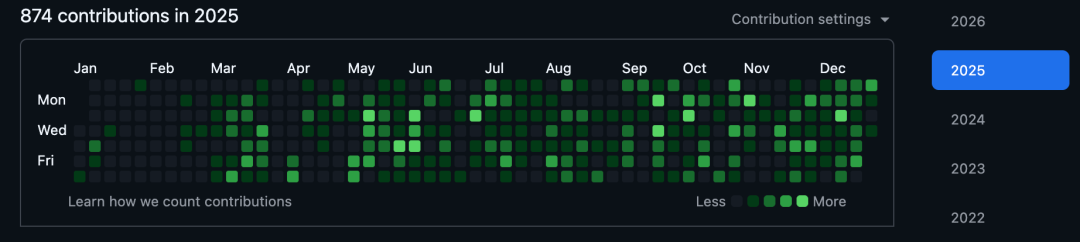
I still cannot write TypeScript fully by hand.
But if you ask me about choosing between Next.js and SPA, splitting an agent framework, implementing modules, weighing cloud services, SEO, or dynamic model routing, I can talk about all of it.
To me, giving requirements to AI is not that different from giving requirements to developers when I was a product manager. It may even be less stressful and more efficient.
The essence is to give away repetitive work, and pull people back from execution into thinking.
05 - AI First
Looking back at the past year, one very important point was AI first.
We used AI in many different parts of the work.
But there is a premise: people have to think clearly first.
If you think clearly, AI can do good work. If you do not understand the problem, AI will only amplify the mistake. As I said earlier, AI’s ceiling depends on you.
Here are a few real examples from inside our team.
The first is data insight.
We do not have a traditional BI system now, nor a heavy fixed reporting system. People have asked me to build one, and I refuse every time.
Even without that, the amount of information I see every day is already higher than in many projects I worked on before.
BI is not bad. I just feel that for us, what I need more is insight that can answer “right now, immediately, tell me.”
Two of our best agents in 2025 were:
-
A log agent: it watches logs, finds errors, and opens issues.
-
A data analyst agent: it watches the database. Yes, I gave it database permissions directly.
So I can see dynamic reports every day, and I can ask follow-up questions whenever I want:
- Why did registrations spike today?
- How should we attribute paid users this week?
- Why is the payment rate low in country X?
The second example is risk control.
We also have an agent that analyzes risky users and automatically bans or blocks them. Compared with scheduling engineering work separately or buying a third-party service, this approach is more flexible and more cost-effective.
That agent came from a sudden idea last month. Kimi gave me a very large membership plan, so I wrote a small agent and let Kimi stand guard. So far, its identification accuracy is still 100%.
So: do it. Do not argue forever. If you have that time, start building.
Any machine work that can be turned into a process, verified, and repeated will be remade by AI. Your job is not to resist it. Your job is to define the problem clearly, build the rules, and take the upside.
06 - Launch
Finishing the product is only the beginning.
Going out into the world is where things really start. But how to go out is actually the hardest problem.
At the very beginning, we made several decisions that many people might not understand, but they worked for us.
We spent almost no budget on marketing.
It was not “disciplined spending.” We simply had no money.
Almost all of our budget went to tokens, in exchange for user feedback that could help us polish the product.
Some people may say: without marketing there is no traffic, and without traffic who will give you feedback?
Not exactly. A good product can grow by itself.
At the same time, we also tried to control traffic. Many people do not understand this either. Everyone says customer acquisition is expensive, so why would we not want more users?
Because not all traffic is worth having, especially for AI products.

We controlled traffic for two reasons:
-
Big spikes and drops can destroy the team’s rhythm.
Traffic spikes feel good for a few days. But when the tide goes out, I am afraid I will feel lost.
-
The more non-target users you have, the more easily the product gets pulled off course.
The AI era is different from the traditional internet era. A lot of “high-interaction feedback” is not the same as high-value feedback. If the people coming in are not your target users, the requirements they raise will probably drag you away from the main route.
And for an AI product, converting a customer is not only about customer acquisition cost. You also have to think about token cost.
So over the past year, I rarely talked about the product actively on my own public account or in my acquaintance circle.
It was not because I did not want to. Even if people in the circle knew about it, there would be no real benefit other than them saying, “nice, impressive.”
At one point we did spend a small amount of money to buy a backlink from a directory site.
Several of us hesitated for a long time before doing it, because at that stage, positive feedback was also a kind of lifeline.
We also took advantage of some communities and events along the way: WaytoAGI, Guancha, and many friends who were willing to give us exposure.
We met some investors too.
Honestly, at the time I also had moments of impulse, wondering whether we should quickly pull exposure up.
But after a while, I calmed down.
When you have no money, do not join the excitement too early. Polishing the product comes first.
Because we knew very clearly that the easiest mistake at that stage was to treat “it looks like we are growing” as “we are really growing.”
If the core product value has not stood up yet, more exposure can make you die faster.
Looking back, our launch method was not sophisticated, but it fit a team like ours.
If I had to summarize it in one sentence:
Put limited resources into user value first, then make growth actions low-cost, reusable, and verifiable.
07 - Finally
This really is the best era.
I am not necessarily encouraging everyone to start a company, but I do want to encourage everyone to keep learning.
I have lived through the internet era, the mobile internet era, and now the large model era. My feelings can be summarized like this:
-
This is a time when the order is being rebuilt.
-
Forget the baggage of past experience, or it will hurt you.
-
Do not be afraid of big companies copying you. You can copy big companies too, and they may not be able to copy you as well.
-
Technology access, model access, and capability thresholds are all being rewritten. Thinking is what creates the gap.
-
Again, forget the past and learn how to let AI help you.
-
Spend less time browsing and more time practicing. High-value information will not be handed to you by others.
Original
This article was first published on the WeChat Official Account “白苏Elliot”: https://mp.weixin.qq.com/s/4TI3svoL8Ub1lfQpPpHlmw