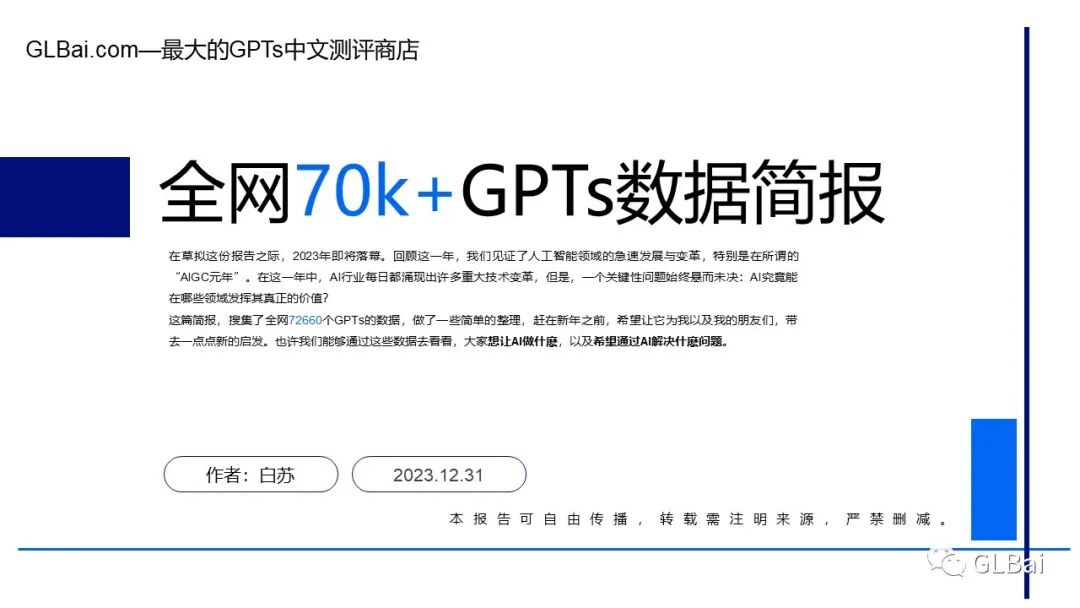
It has been less than two months since OpenAI announced GPTs in November, and the number of GPTs created across the web is already approaching 100,000-plus.
BeBeGPT Store is one of the largest Chinese GPTs stores. Beyond ranking near the top in the number of GPTs collected, it uses large language model technology to automate site updates and operations through Coding + AI. Compared with similar sites, it provides more complete Chinese translation, categorization, and AI reviews of GPTs, helping users find target GPTs faster and use AI-generated reviews as an extra judgment signal.
On the last day of 2023, as a small New Year gift, I cleaned and updated the 72,660 GPTs currently collected by BeBeGPTs and counted conversation usage data for all collected GPTs. The goal was to provide a reference dataset for people working in the AI industry.
Reply with “gpts” to get the PDF file.
This data brief looks at three simple dimensions: creation trends, usage counts, and creator-related data. Since the official side has not released a complete GPTs directory, all data was updated through search engines, so the final statistics should only be treated as a reference.
Overview
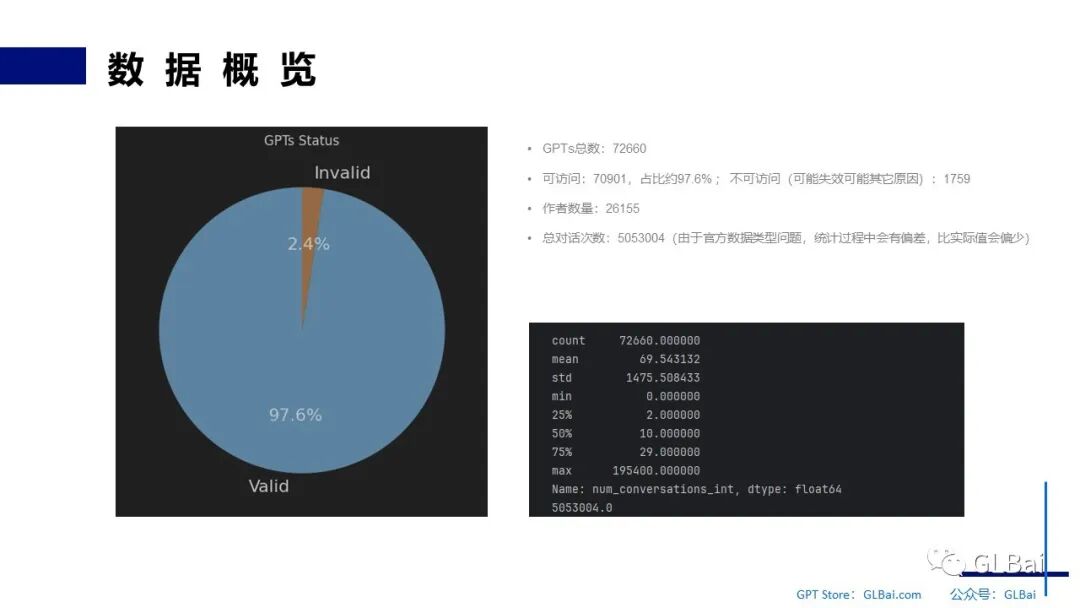
Among the 72,660 GPTs included in the statistics, 1,759 were invalid. Most of these were probably caused by creators turning off external access.
The creators behind these 70,000-plus GPTs reached 26,155 people.
Considering shared accounts, the real number of creators should be higher than that.
Trends
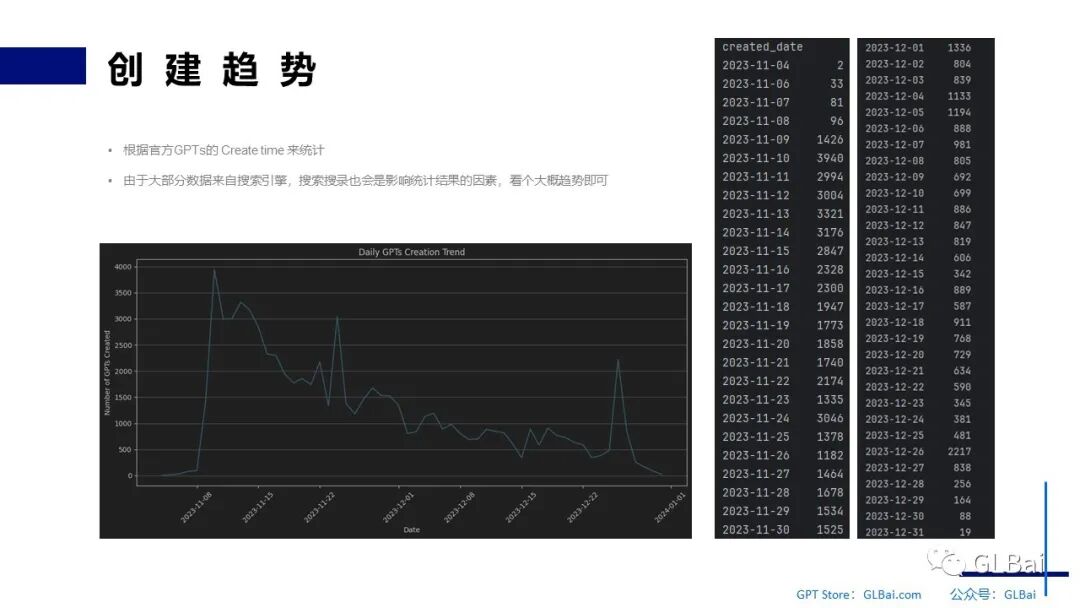
GPTs were officially released to the outside world around the 10th, I think?
The 10th had the highest number of creations, reaching 3,940, and then the number declined all the way down. There were two small rebounds in between, but both were short.
The decline later may partly be a search engine indexing issue. There is a time lag, although OpenAI pages should be indexed the next day or even the same day. It is also possible my program simply did not crawl everything. Another reason may be simpler: people’s brains do run out of ideas.
Ranking
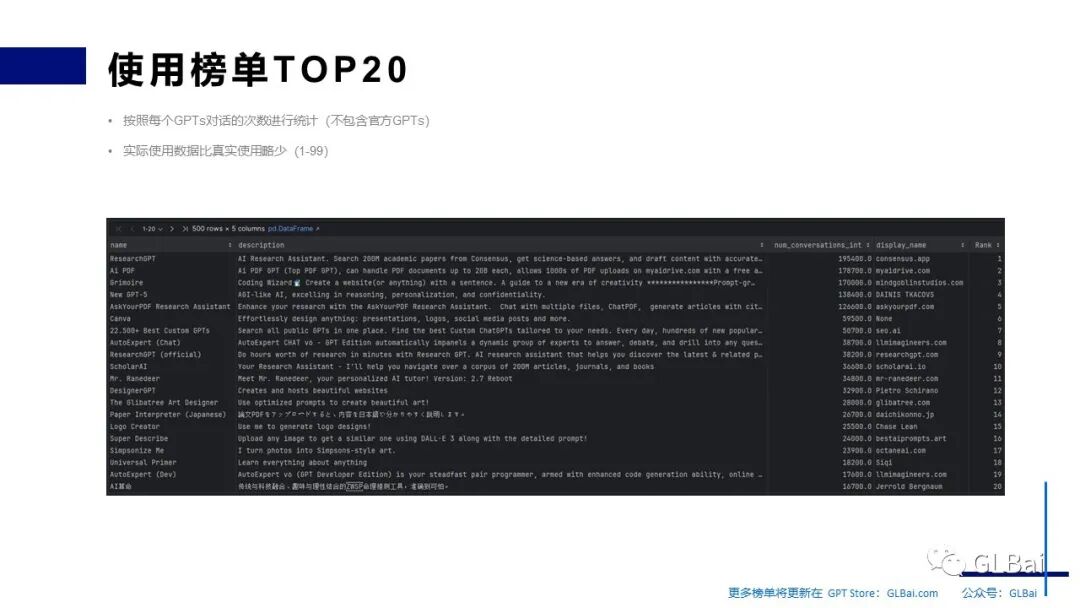
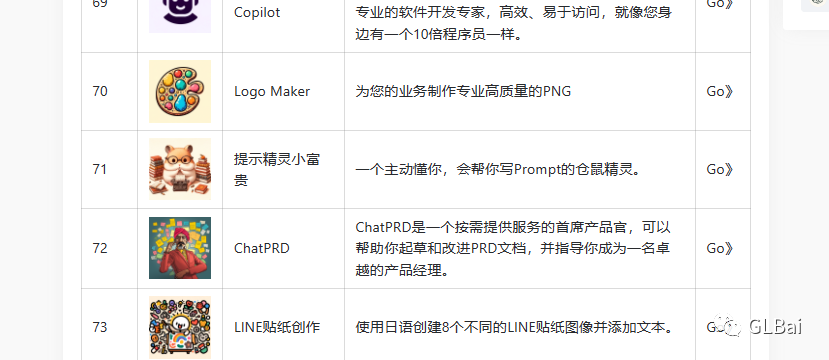
I compiled a TOP 100 ranking by conversation count. The corresponding links have already been published on BeBeGPTs. You can open the original link to access them.
Among the TOP 100, there are seven Chinese GPTs, maybe more if some creators went directly overseas. One of them is our good friend Chen Caimao’s prompt series, Prompt Genie Xiao Fugui, currently ranked 71 and very useful.
Word Cloud
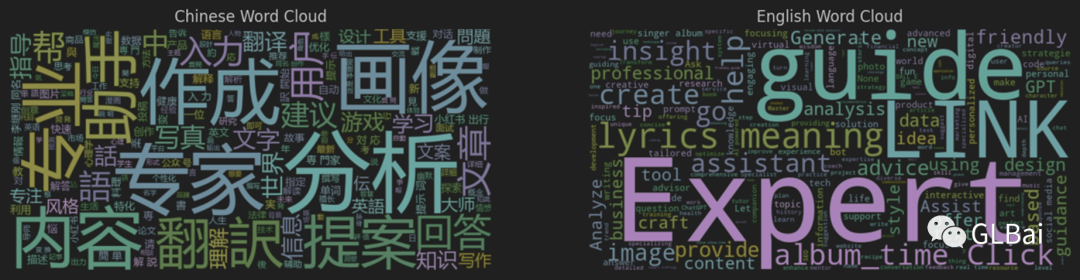
I pulled out names and descriptions, segmented the text, and ran a word-frequency analysis. There were a few problems. Japanese and Chinese share some words, which makes it hard to separate Chinese GPTs completely. Also, the stopword list for segmentation was incomplete, so I had to keep adding and adjusting words manually. The final result looks like this.
In practice, many GPTs creators did not write good descriptions when creating GPTs. That makes it hard to tell what a GPT actually does just from its name and description.
Categories
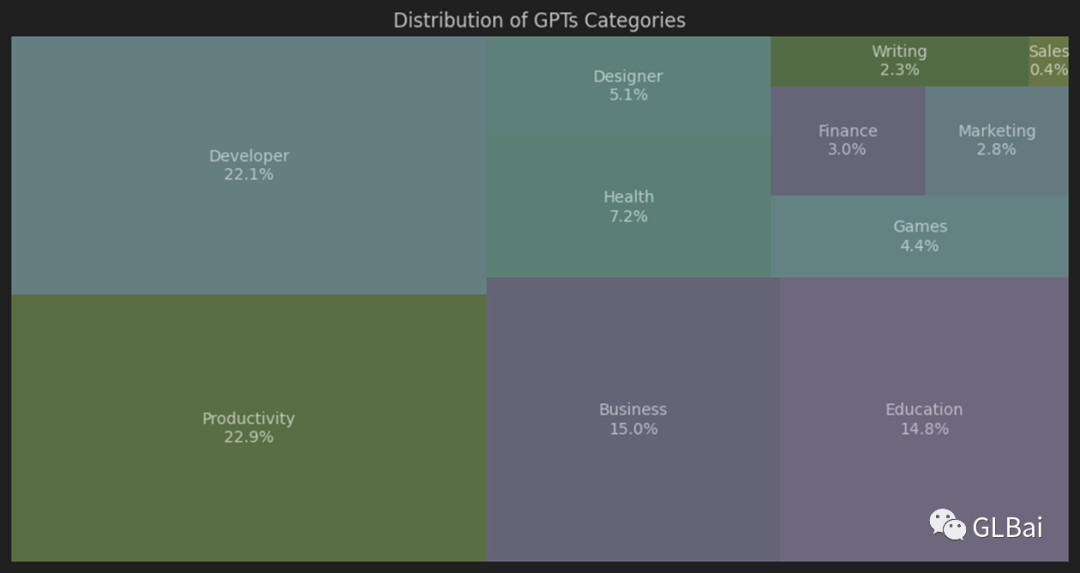
All current category data is classified by GPT. Because concurrency is still limited, only 30,000-plus have been categorized so far.
Also, when I originally designed the category table, I did not expect so many GPTs to be created later. The categories are now not enough, neither broad enough nor detailed enough. I will probably reclassify them when I have time.
I originally thought Sales would have the strongest relationship with money, but the data is pitifully low. Is sales bad at using AI, or can AI not replace sales? It may be worth studying whether SaleGPTs is a worthwhile direction.
If there is any other data you want to know, feel free to leave a comment.
Original
This article was first published on the WeChat Official Account “白苏Elliot”: https://mp.weixin.qq.com/s/SaCIDKn8om0Ex_eCetxjCA