The flu has been everywhere lately, so take care of yourself.
It has been exactly half a month since my last post. I did not keep up the weekly schedule. Partly because the flu dragged me through the mud, and partly because I was using an AI Agent to do something pretty interesting.
This post is a careful write-up of how I asked AI to help me build a website, and how that site passed 100 daily unique visitors and 1,000 pageviews on its first day online.
GPTs Store
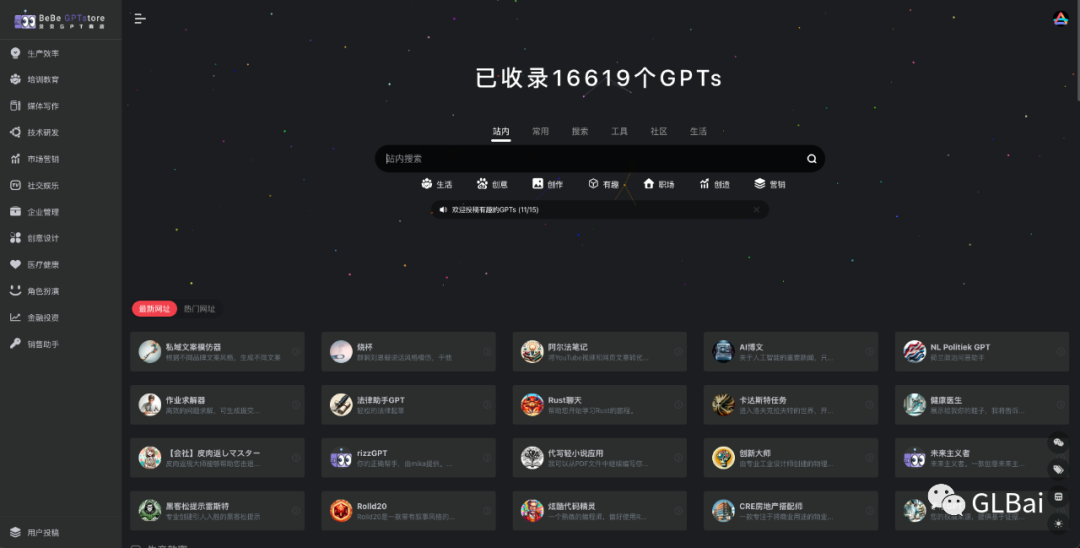
I mentioned this site in the previous post. Some readers who follow along may have already seen it.
It is a directory site for collecting GPTs. At the moment, more than 9,000 GPTs have been published, with another 8,000-plus waiting to be organized and released.
If you only look at the website itself, it may not seem especially remarkable.
But if I tell you that roughly 80% of the work was done by an AI Agent, does it feel a little different?
Since OpenAI released GPTs, many people have built GPTs store websites. There is not much of a threshold. But if you look closely, whether it is GPTHunter or other GPTs stores, most of them only collect simple GPTs data, either by scraping or crawling.
So what did this site do differently?
- Categorization
Whether it is GPTHunter or other stores, most of them basically did not do categorization.
GPTHunter redesigned its UI around last week and added categories, but the amount of categorized data still seems to be a very small proportion.
Why is categorization missing? It is not that people do not want to categorize. It is that manually organizing hundreds or thousands of records in just a few days is almost impossible.
But for AI, this is trivially easy.
- Translation
This site is positioned as a Chinese GPT store.
My original intention was to collect everyone’s weird and wonderful ideas, to see the power of UGC, and maybe discover more interesting thinking along the way.
So Chinese had to be the main language. In reality, most native GPTs data is in English, with smaller portions in Japanese, Chinese, and even Arabic. Translation is unavoidable.
And again, this is something AI is good at.
- Commentary
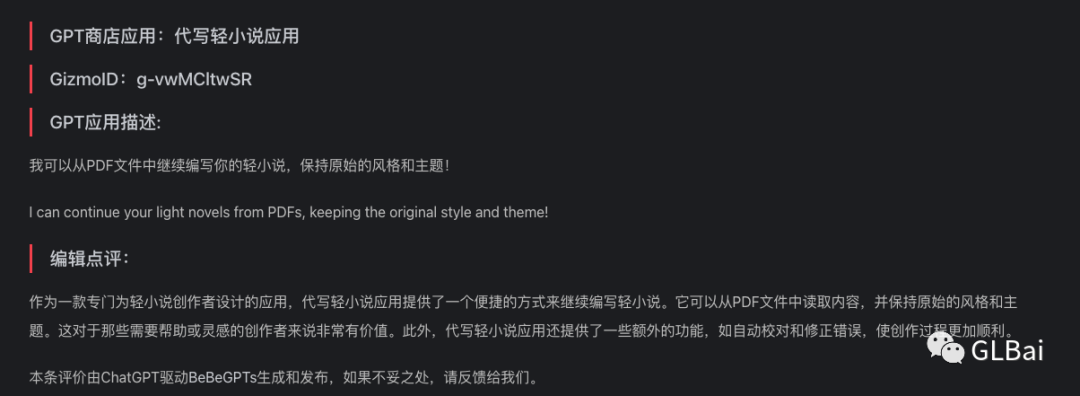
Beyond the name, description, and avatar that every store has, this site also adds commentary for each GPT.
Of course, AI does this part too.
Some of the comments may not look especially accurate yet, or may drift off topic.
That is because my prompt was not good enough. I will optimize it later and rewrite that batch.
As for where the data came from: the earliest dozens of GPTs were added manually by me. Later data came from Google.
After manually adding items for about an hour, I really could not stand it anymore. After so many years doing product work, looking for a better way to solve a problem has become a habit.
And that is how the site’s editor Agent was born.
Data Collection
The first wave of GPTs data came from GitHub, adding up to about a hundred entries.
I gave the Agent several tools for processing data.
Avatar Mirroring
All avatars on the site are mirrored to COS, just in case some friends in China cannot access the original images. After the Agent gets an avatar URL, it handles this work.
Fetching Names and Descriptions
Search Google for site:chat.openai.com/g. If a result is not already in the database, it is saved one by one and waits for the editor Agent to enrich it.
GPTs Editing
The data saved above is not published directly. It is just raw data. This is where the editor Agent comes in.
-
Pull the records waiting to be edited from the database.
-
Based on all visible data, which is basically the name, description, and conversation starters, write a short comment on the GPT, translate the content into Chinese, and choose a category for it.
-
Publish the GPT to the website.
What Happened Next
From the birth of the idea to implementation and launch, the whole thing took three days.
Apart from posting one WeChat article, I did no extra promotion. The first day passed 100 UV, and traffic kept rising afterward. I was happy, mostly because the idea had been turned into a real thing quickly and had received some validation.
Because time was tight, I did not write the prompts very carefully at first. Also, GPT-3.5 still needs a lot of prompt shaping, so I am not actually very satisfied with the current effect. I will keep optimizing the prompts so the GPTs introductions become more useful.
I also plan to add some ratings, though that feature still needs to be validated.
Easter Egg
On the third day after the website launched, a friend who runs a relay service contacted me and said GPTs could be called through a relay API.
In other words, you could use GPTs directly without subscribing to ChatGPT. So I worked overtime that night and exposed the gizmo_id needed by the relay service separately.
If you are interested, you can study it. If I have time, I may also release a standalone API.
Original
This article was first published on the WeChat Official Account “白苏Elliot”: https://mp.weixin.qq.com/s/SDgGv2dBxkiEa5L_3jJyOg